





 Home
Home Hemangioma Treatment

Hemangioma: Understanding This Common Vascular Condition
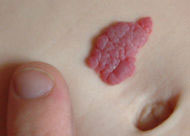
A hemangioma is a benign (non-cancerous) vascular growth that commonly appears in infants. It develops due to an abnormal proliferation of endothelial cells, which line blood vessels. Although its appearance can be concerning for parents, most hemangiomas are harmless and tend to improve naturally over time without medical intervention.
Types of Hemangioma
Infantile Hemangioma
This is the most frequently observed type. It usually appears within the first few weeks after birth. The lesion grows rapidly during the first 6–12 months of life, known as the growth phase, and then gradually shrinks over several years. In most cases, it completely resolves by early childhood.
Congenital Hemangioma
This type is present at birth and fully developed from the beginning. It is further classified into:
- RICH (Rapidly Involuting Congenital Hemangioma) – Shrinks quickly after birth
- NICH (Non-Involuting Congenital Hemangioma) – Does not regress and may remain stable
How Common Is It?
Hemangiomas affect approximately 4–10% of infants. They are more frequently seen in:
- Female babies
- Caucasian populations
- Premature or low-birth-weight infants
They are relatively uncommon in African-American infants.
Causes and Origin
Hemangiomas are not inherited and are not linked to anything the mother did during pregnancy. Current medical understanding suggests they result from a spontaneous mutation in primitive endothelial stem cells during fetal development.
Common Locations
Hemangiomas can appear anywhere on the body, but typical distribution includes:
- 60% on the head and neck
- 25% on the trunk
- 15% on the limbs
In rare cases, they may develop internally, affecting organs such as the liver, gastrointestinal tract, or brain.
Appearance and Types
- Superficial hemangiomas: Bright red, raised lesions often called “strawberry marks”
- Deep hemangiomas: Bluish lesions located beneath the skin
- Congenital forms: May appear as large, grayish lesions with visible blood vessels at birth
Possible Complications
Most hemangiomas do not cause complications. However, in some cases, issues may include:
- Skin ulceration or infection (5–10%)
- Occasional bleeding (rare)
- Interference with vision, breathing, or hearing depending on location
- Facial asymmetry or scarring in severe cases
- Very rarely, internal complications such as bleeding or heart strain (~1%)
Diagnosis
In most cases, diagnosis is made through clinical examination. When needed, imaging tests such as ultrasound, MRI, or CT scans help assess deeper involvement. Biopsy is rarely required unless malignancy needs to be ruled out.
Treatment Options
Most hemangiomas do not require active treatment and are simply monitored over time. Intervention is considered when the lesion:
- Affects vital functions (breathing, vision, feeding)
- Becomes ulcerated or repeatedly bleeds
- Causes significant cosmetic or structural concerns
Medical Management
- Corticosteroids
- Vincristine
- Interferon (in selected cases)
Surgical Treatment
Used for cases involving airway obstruction, eyelid involvement, or severe disfigurement.
Laser Therapy
Laser is mainly used for residual redness or superficial vascular changes. It is not typically used to remove active hemangioma tissue but can improve cosmetic appearance after regression.
Prognosis and Long-Term Outcome
The majority of hemangiomas naturally regress over time, often leaving little to no visible trace. If cosmetic concerns remain, corrective procedures such as laser therapy or minor surgery can be considered, usually before school age for optimal aesthetic results.
Advanced Care in Bangkok
At specialized clinics in Bangkok such as Yoskarn Clinic, patients can access expert evaluation and tailored treatment plans for vascular lesions, ensuring safe monitoring and advanced cosmetic correction when needed.
RELEVANT PROJECT
-
Acne Extraction Treatments
-
AHA + Acne Mask Treatment
-
Miracle Smooth Microneedling Therapy
-
Professional Dermabrasion
-
CO2 Laser Skin Resurfacing
-
Advanced Vascular Laser Therapy
-
Dual Yellow Laser
-
IPL Skin Rejuvenation
-
Newborn Skin Laser Rejuvenation
-
Fractional CO2 SmartXide Laser
-
Made Collagen Therapy
-
Chemical Peel
-
Revlite Q-Switched Laser
-
Laser Skin Resurfacing
-
Botox Anti-Wrinkle Injections
-
PRP Vampire Facial
-
Mesotherapy Skin Rejuvenation
-
Melasma Treatment
-
Rosacea Treatment
-
Dark Lips and Gum Pigmentation
-
Dark Underarm and Groin Pigmentation Treatment
-
Facial Telangiectasia (Broken Capillaries) Treatment
-
Couperose and Spider Veins Treatment
-
Dermal Filler Injections
-
Ultherapy Thailand
-
HIFU Treatment
-
lipodissolve Bangkok
-
ThermiTight in Bangkok
-
Silhouette Soft Thread Lift
-
Mesolift Skin Rejuvenation
-
Acne & Scar Solutions

